Real time by default
An event bus sits under every module, so a change in the shop, on the road or in accounting reaches every connected screen the moment it lands. No snapshot, no manual refresh, no stale board.
Vektra is a transportation management system for asset-based carriers across North America, from a dozen trucks to a few hundred. Load to settlement on one screen, every change pushed the moment it happens, priced per truck.
Unlimited users · Month to month · Guided migration
Positions come straight from Motive, Samsara, Geotab or Isaac. A fix older than two hours is drawn differently and counted separately — a stale position drawn like a live one is a map that lies about where your fleet is.
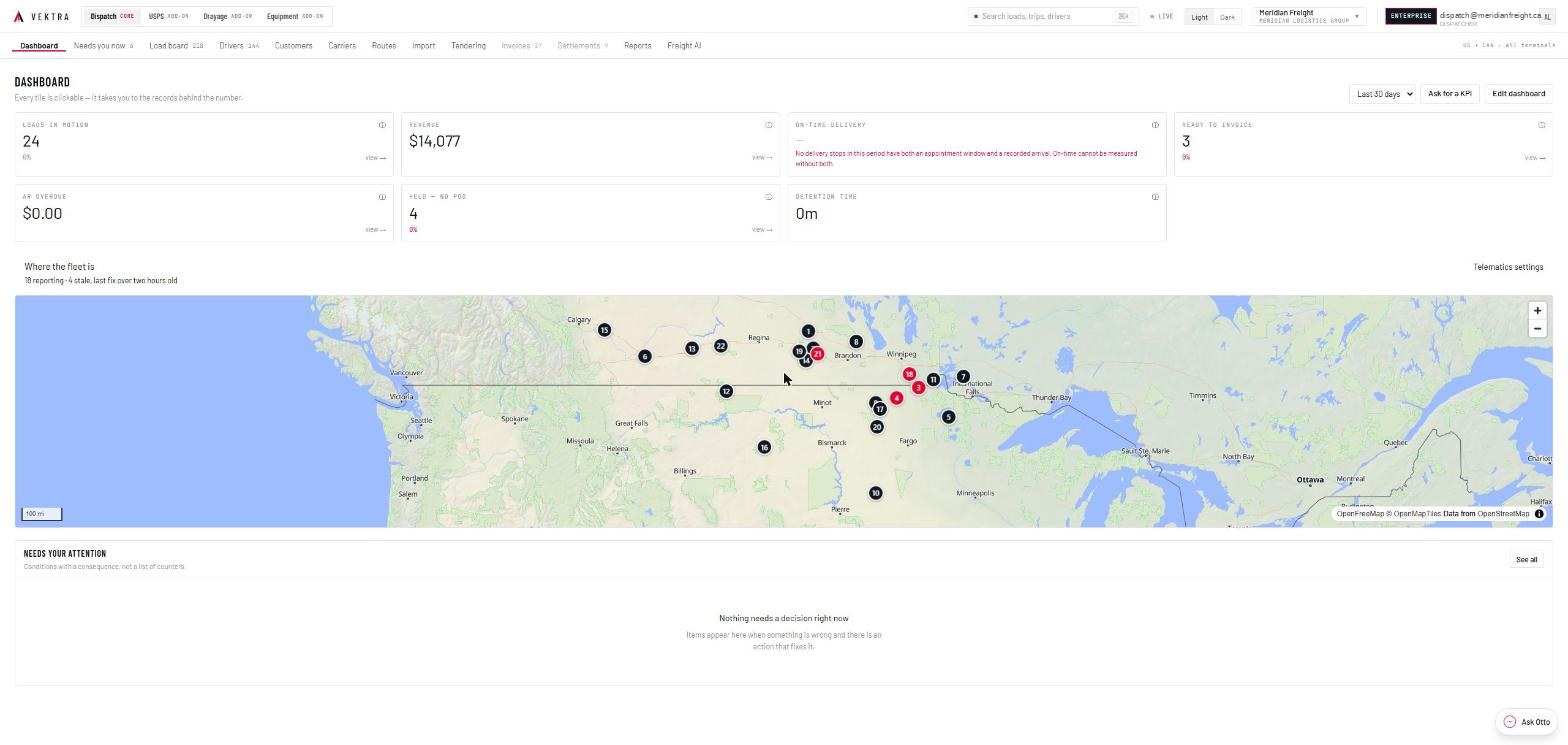
Booked through to ready-to-invoice on one screen, with the lane, the driver, the unit and the margin on every row. Status changes inline — no drawer, no second page, no save button to hunt for.
Revenue and margin sit on the board itself, because a dispatcher moving a load is the person best placed to notice when one is not worth moving.
See the rest of the platform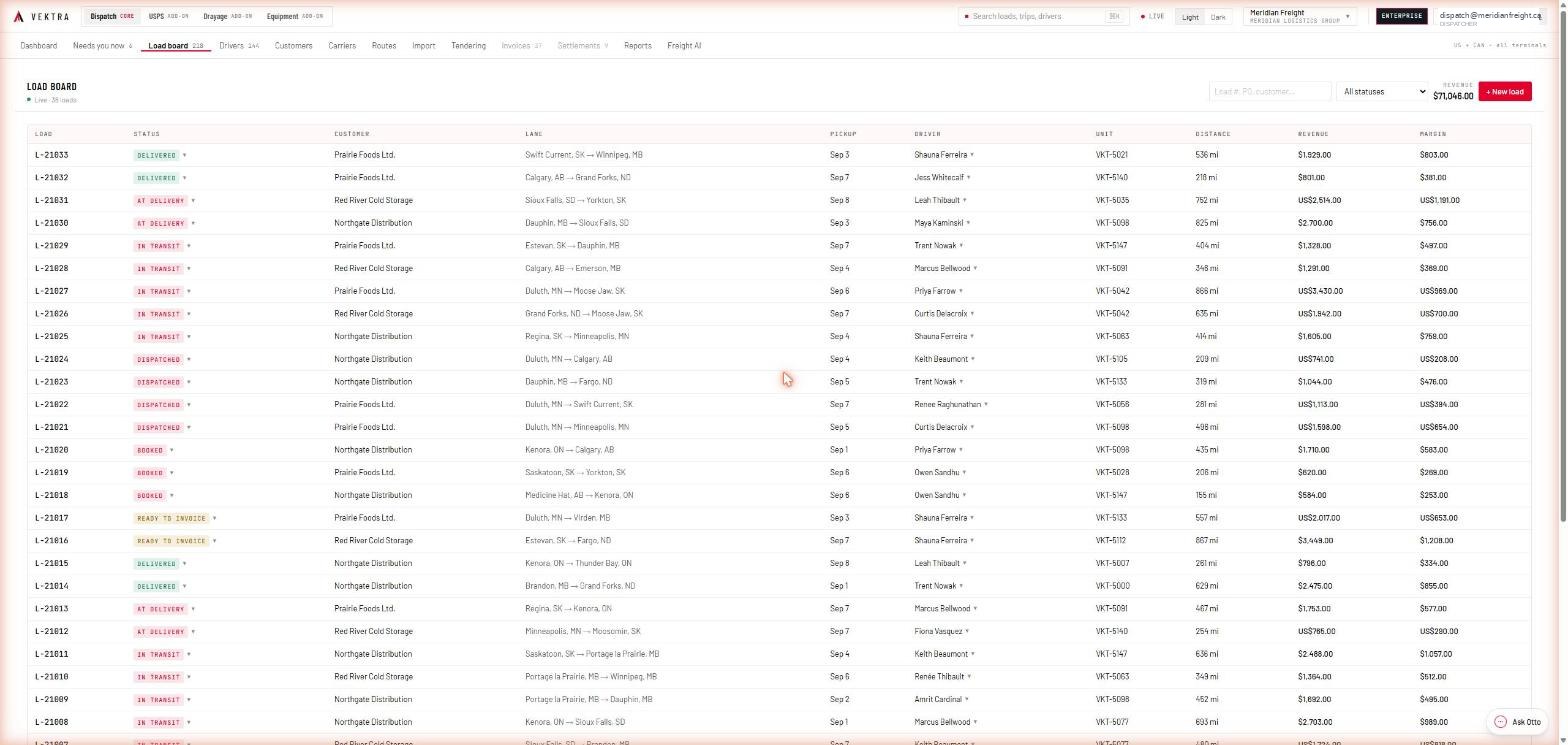
In most transportation software, maintenance is a filing cabinet. A mechanic writes up a unit, the record sits there, and dispatch assigns a load to that truck the same afternoon because nothing stopped them.
Vektra treats it as one system. Placing a maintenance hold flips the asset out of service immediately, flags every load already booked on it, and refuses the next dispatch attempt outright. If someone genuinely needs to override, they can — and the override is written to the audit log with their name on it.
An event bus sits under every module, so a change in the shop, on the road or in accounting reaches every connected screen the moment it lands. No snapshot, no manual refresh, no stale board.
Every screen in Vektra is built on the same documented, versioned API a partner integrator would use. Nothing is reachable through the UI that you can't reach programmatically.
A tight core — loads, carriers, assets, settlement — with add-on modules like Equipment Maintenance and USPS contract management on top. You run what your operation needs.
Your bill tracks the trucks you run, not the seats you fill. Dispatch, accounting, drivers, the owner and your bookkeeper all get a login at no extra cost.
Every operation below has a compliance or documentation demand that most TMS platforms treat as a custom field. In Vektra they're part of the data model.
FTL, LTL and mixed operations. One board, one record from booking to settlement, no rekeying between dispatch and accounting.
Tight timelines, welfare documentation and hours-of-service edge cases that a generic load record cannot represent honestly.
Temperature capture attached to the load, precool verification, and exceptions flagged before they turn into a rejected claim.
Oversize permits, project-based invoicing and equipment records that don't collapse into a single "trailer" field.
Contract routes modelled properly: trips, parts, frequency codes and holiday-offset rules, with expiry that blocks generation at the source.
Tell us what you haul and where the paperwork hurts. If Vektra can't represent it properly today, we'll say so rather than sell you a workaround.
Enter it once, take it in over EDI, or post it through the API. Customer, lane, rate, equipment and accessorials live on one record from that moment forward.
Dispatch to a truck that's actually available, the driver gets the load on their phone, the customer watches it move on a link, and the signed POD comes back attached.
Invoice with the paperwork already attached, settle the driver against the same load, and post it to your accounting without anyone retyping a number.
The API isn't a bolt-on for enterprise customers. It's the contract the product itself is built against, documented from the same source, so what you integrate with is what we run.
POST /loads/4417/assign
// dispatching onto an asset under a maintenance hold

400 Bad Request
{
  "error": "ASSET_UNDER_MAINTENANCE_HOLD",
  "assetId": "unit-118",
  "holdId": "mc_9f21",
  "override": "pass overrideHold:true — audited"
}
"Most transportation software is built for brokerages with a hundred seats and sold to carriers as an afterthought. Vektra started at the dispatch desk instead."
Alister — CEO & Principal Engineer
Read the whole storyVektra is in active development and we are onboarding a small group of founding carriers now. We would rather tell you that plainly than pretend to be a decade old. If you need a fully mature platform this quarter, we will say so on the call. If you want influence over how a TMS gets built for your operation, this is the moment to talk.
Per truck, per month, month to month, with unlimited user seats at every tier. Published ranges are on the pricing page and we will give you a real number for your fleet size on the demo call rather than making you chase a quote.
The incumbents are mature platforms with years of production history, and we are not going to pretend otherwise. Where Vektra is different is architectural: real-time event propagation instead of a board you refresh, a maintenance layer that can actually stop a dispatch, and an API that covers the whole product rather than a subset. Whether that matters more than maturity depends on your operation, and we will give you an honest read on the call.
Migration is guided and included. We move your customers, lanes, equipment, driver records and open loads, and we agree on what historical data comes across before you sign anything. Your data stays exportable the entire time you are with us.
No. Vektra is designed to sit alongside the tools you already run. Tell us your stack on the demo call and we will confirm exactly what connects today, what is on the roadmap, and what would need a custom integration — before you commit, not after.
Thirty minutes. Bring your worst week — the re-power, the truck that went down mid-lane, the settlement nobody can reconcile — and we'll show you where it goes.