Dispatch & load board
Build the load once. Assign the truck, the driver and the trailer, see the whole board by day, and cover a re-power without rekeying a thing. The board updates itself as events land.
Every module below writes to the same record and publishes to the same event bus. That's why a maintenance hold can stop a dispatch, and why your invoice and your driver settlement can't disagree about what a load paid.
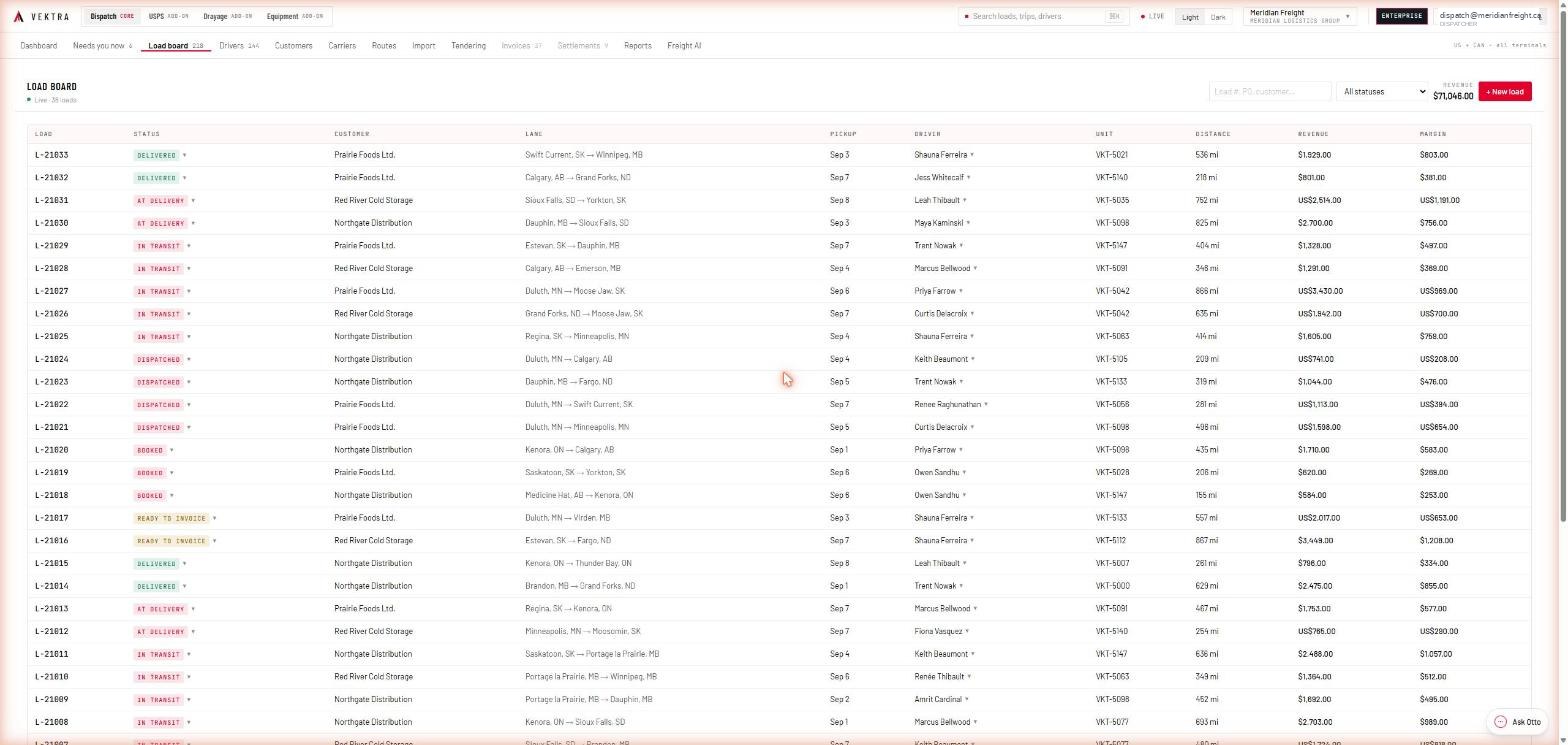
Build the load once. Assign the truck, the driver and the trailer, see the whole board by day, and cover a re-power without rekeying a thing. The board updates itself as events land.
Live positions and honest arrival times on every load, so the check call stops being a phone call and becomes a link you send to the customer.
Tractors, trailers, inspections and service intervals tracked against the equipment record — with holds that reach dispatch instead of sitting in a file.
Rate confirmations, BOLs and signed PODs attached to the load they belong to. Scanned from the cab, filed automatically, billed against.
Invoice the customer the day the load delivers, and settle drivers and owner-operators against the same numbers. Percentage, mileage or flat.
Give shippers their own view: loads in progress, documents, invoices. They answer their own questions and your phone stays quiet.
Company drivers, owner-operators and outside carriers on one roster, with the pay structure, documents and compliance dates that belong to each.
Revenue per mile, per truck, per customer and per lane. Deadhead, on-time percentage, detention exposure, and what each driver actually earned you.
Invoices, payments and settlements flow into your books instead of being typed there twice. Your bookkeeper keeps the software they already know.
Legacy platforms hand you a snapshot with a timestamp and a refresh button. Every dispatcher learns to distrust it, and the ones who don't get burned by it.
Vektra publishes every meaningful change — a status flip, a hold, a POD landing, a load flagged — onto an internal event bus, then pushes it straight to every connected screen over a live socket. What's on the board is what's true.
This is the module Vektra was designed around, and the clearest example of what "one system" actually buys you.
A scheduled service, a failed inspection item, or a predictive cycle coming due. One action, from the shop's own screen.
The unit flips out of service across every open session immediately, and any load already booked on it is flagged for reassignment rather than quietly left broken.
The next attempt to assign that unit is refused outright. An override is possible, requires an explicit decision, and is written to the audit log with a name attached.
The same pattern applies wherever a status should have consequences: an expired contract stops generating trips at the source, and unlinked telematics becomes a decision item with a real cost attached — "three loads tonight have no live tracking" — instead of a counter people learn to ignore.
Vektra's own screens are built on the same documented, versioned REST API that you and your partners get. There's no privileged internal backdoor, which means the integration surface can't quietly rot behind the UI.
GET /events/stream?topics=asset,load

// pushed the moment the shop places the hold
{
  "type": "asset.status.changed",
  "assetId": "unit-118",
  "from": "AVAILABLE",
  "to": "IN_SHOP",
  "cause": "maintenance.hold.placed",
  "affectedLoads": ["T-4417"]
}
Compliance and back office are where a TMS quietly stops being worth it. These are built, not roadmap.
Quarterly mileage split by jurisdiction, derived from position history rather than a spreadsheet somebody keeps by hand. Every figure carries its coverage and the distance we could not account for, because a number you cannot reconcile is worse than no number.
Remaining drive, shift and cycle hours pulled from the ELD and applied when a load is assigned. A driver without the hours is flagged before the plan is made, not after the truck is loaded.
Deductions with recovery caps, escrow with a target balance, and accessorial pay rules per driver — so 70% of a tarping fee lands on the load’s margin without anyone doing arithmetic.
One screen, one button. It works out which of today’s loads the driver is starting and says why. Equipment swaps from the cab land on the dispatch board immediately — a driver hooks whatever is on the yard at 05:00, and the record should follow.
Take a 204 from a shipper, or offer a load out to a carrier — over EDI, or straight across to another organisation you run. Unanswered offers expire, because a tender nobody declined is not capacity you have.
Invoices and settlements as balanced journal entries for QuickBooks or Sage. Anything that will not balance is named and held back rather than exported into a suspense account for someone to find at quarter end.
Nothing here asks you to rip out your ELD, change banks or fire your bookkeeper.
We're early, so we'll be straight with you: some of these are connected and running, some are built and waiting on a live account to test against, and some are on the near roadmap. Bring your exact stack to the call and we'll tell you which is which, per vendor, before you sign anything — not after.
Motive, Samsara, Geotab and Isaac. Positions, odometer and hours in — and loads back out to the driver’s in-cab device.
QuickBooks and Sage. Invoices, payments and settlements as journal entries, balanced before they leave.
204 tenders, 990 responses, 214 status and 210 invoicing over SFTP, AS2 or your VAN. No per-transaction fee on TMS tiers.
Comdata, EFS and WEX. Real cost per mile instead of an estimate, and the fuel half of an IFTA return.
FourKites. Matters most for USPS contractors, whose scores officials read straight out of it.
Submit invoices and reconcile advances without re-keying. Recourse exposure tracked, which no ageing report shows you.
On the near roadmap. Tell us which one you live on and it moves up.
Routing, distance and geofenced arrival built in, not billed per lookup.
Everything above is reachable programmatically, because the product is built on the same API.
We don't do generic walkthroughs. Tell us your freight type, your current system and the thing that keeps going wrong, and we'll show you exactly where it lands in Vektra.